

[2024] Pass ISC CSSLP Test Practice Test Questions Exam Dumps
Verified CSSLP dumps Q&As - CSSLP dumps with Correct Answers
NEW QUESTION # 84
You are advising a school district on disaster recovery plans. In case a disaster affects the main IT centers for the district they will need to be able to work from an alternate location. However, budget is an issue. Which of the following is most appropriate for this client?
- A. Cold site
- B. Off site
- C. Warm site
- D. Hot site
Answer: A
Explanation:
A cold site provides an office space, and in some cases basic equipment. However, you will need to restore your data to that equipment in order to use it. This is a much less expensive solution than the hot site. Answer D is incorrect. A hot site has equipment installed, configured and ready to use. This may make disaster recovery much faster, but will also be more expensive. And a school district can afford to be down for several hours before resuming IT operations, so the less expensive option is more appropriate. Answer C is incorrect. A warm site is between a hot and cold site. It has some equipment ready and connectivity ready. However, it is still significantly more expensive than a cold site, and not necessary for this scenario. Answer B is incorrect. Off site is not any type of backup site terminology.
NEW QUESTION # 85
Which of the following security models dictates that subjects can only access objects through applications?
- A. Clark-Wilson
- B. Biba-Clark model
- C. Biba model
- D. Bell-LaPadula
Answer: A
Explanation:
Explanation/Reference:
Explanation: The Clark-Wilson security model dictates that subjects can only access objects through applications. AnswerA is incorrect. The Biba model does not let subjects write to objects at a higher integrity level. Answer: B is incorrect. The Bell-LaPadula model has a simple security rule, which means a subject cannot read data from a higher level. Answer: D is incorrect. There is no such model as Biba-Clark model.
NEW QUESTION # 86
DRAG DROP
A number of security design patterns are developed for software assurance in general. Drag and drop the appropriate security design patterns in front of their respective descriptions.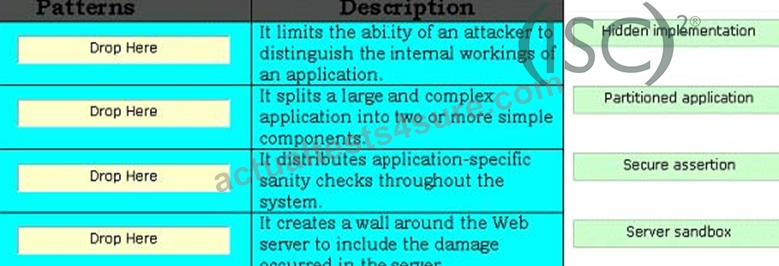
Answer:
Explanation:
Explanation:
The various patterns applicable to software assurance in general are as follows: Hidden implementation: It limits the ability of an attacker to distinguish the internal workings of an application. Partitioned application: It splits a large and complex application into two or more simple components. Secure assertion: It distributes application-specific sanity checks throughout the system. Server sandbox: It creates a wall around the Web server to include the damage that occurs because of an undetected fault in the server or an exploited vulnerability.
NEW QUESTION # 87
You have a storage media with some data and you make efforts to remove this data. After performing this, you analyze that the data remains present on the media. Which of the following refers to the above mentioned condition?
- A. Degaussing
- B. Residual
- C. Object reuse
- D. Data remanence
Answer: D
Explanation:
Data remanence refers to the data that remains even after the efforts have been made for removing or erasing the data. This event occurs because of data being left intact by an insignificant file deletion operation, by storage media reformatting, or through physical properties of the storage medium. Data remanence can make unintentional disclosure of sensitive information possible. So, it is required that the storage media is released into an uncontrolled environment. Answer C and B are incorrect. These are the made-up disasters. Answer A is incorrect. Object reuse refers to reassigning some other object of a storage media that has one or more objects.
NEW QUESTION # 88
You are responsible for network and information security at a metropolitan police station. The most important concern is that unauthorized parties are not able to access data. What is this called?
- A. Integrity
- B. Confidentiality
- C. Availability
- D. Encryption
Answer: B
Explanation:
Explanation/Reference:
Explanation: The CIA (Confidentiality, Integrity, and Availability) triangle is concerned with three facets of security. Confidentiality is the concern that data be secure from unauthorized access. AnswerB and C are incorrect. The CIA (Confidentiality, Integrity, and Availability) triangle is concerned with three facets of security. Integrity is the concern that data not be altered without it being traceable. Availability is the concern that the data, while being secured, is readily accessible. AnswerD is incorrect. Confidentiality may be implemented with encryption but encryption is just a technique to obtain confidentiality.
NEW QUESTION # 89
Which of the following plans is designed to protect critical business processes from natural or man-made failures or disasters and the resultant loss of capital due to the unavailability of normal business processes?
- A. Crisis communication plan
- B. Disaster recovery plan
- C. Business continuity plan
- D. Contingency plan
Answer: C
Explanation:
Explanation/Reference:
Explanation: The business continuity plan is designed to protect critical business processes from natural or man-made failures or disasters and the resultant loss of capital due to the unavailability of normal business processes. Business Continuity Planning (BCP) is the creation and validation of a practiced logistical plan for how an organization will recover and restore partially or completely interrupted critical (urgent) functions within a predetermined time after a disaster or extended disruption. The logistical plan is called a business continuity plan. AnswerC is incorrect. The crisis communication plan can be broadly defined as the plan for the exchange of information before, during, or after a crisis event. It is considered as a sub-specialty of the public relations profession that is designed to protect and defend an individual, company, or organization facing a public challenge to its reputation. The aim of crisis communication plan is to assist organizations to achieve continuity of critical business processes and information flows under crisis, disaster or event driven circumstances. Answer: A is incorrect. A contingency plan is a plan devised for a specific situation when things could go wrong. Contingency plans are often devised by governments or businesses who want to be prepared for anything that could happen. Contingency plans include specific strategies and actions to deal with specific variances to assumptions resulting in a particular problem, emergency, or state of affairs. They also include a monitoring process and "triggers" for initiating planned actions. They are required to help governments, businesses, or individuals to recover from serious incidents in the minimum time with minimum cost and disruption. Answer: D is incorrect. A disaster recovery plan should contain data, hardware, and software that can be critical for a business. It should also include the plan for sudden loss such as hard disc crash. The business should use backup and data recovery utilities to limit the loss of data.
NEW QUESTION # 90
Which of the following describes a residual risk as the risk remaining after a risk mitigation has occurred?
- A. DIACAP
- B. SSAA
- C. DAA
- D. ISSO
Answer: A
Explanation:
DIACAP describes a residual risk as the risk remaining after a risk mitigation has occurred. The Department of Defense Information Assurance Certification and Accreditation Process (DIACAP) is a process defined by the United States Department of Defense (DoD) for managing risk. DIACAP replaced the former process, known as DITSCAP (Department of Defense Information Technology Security Certification and Accreditation Process), in 2006. DoD Instruction (DoDI) 8510.01 establishes a standard DoD-wide process with a set of activities, general tasks, and a management structure to certify and accredit an Automated Information System (AIS) that will maintain the Information Assurance (IA) posture of the Defense Information Infrastructure (DII) throughout the system's life cycle.DIACAP applies to the acquisition, operation, and sustainment of any DoD system that collects, stores, transmits, or processes unclassified or classified information since December 1997. It identifies four phases: 1.System Definition 2.Verification 3.Validation 4.Re-Accreditation Answer D is incorrect. An Information System Security Officer (ISSO) plays the role of a supporter. The responsibilities of an Information System Security Officer (ISSO) are as follows: Manages the security of the information system that is slated for Certification & Accreditation (C&A). Insures the information systems configuration with the agency's information security policy. Supports the information system owner/information owner for the completion of security-related responsibilities. Takes part in the formal configuration management process. Prepares Certification & Accreditation (C&A) packages. Answer C is incorrect. The Designated Approving Authority (DAA), in the United States Department of Defense, is the official with the authority to formally assume responsibility for operating a system at an acceptable level of risk. The DAA is responsible for implementing system security. The DAA can grant the accreditation and can determine that the system's risks are not at an acceptable level and the system is not ready to be operational. Answer B is incorrect. System Security Authorization Agreement (SSAA) is an information security document used in the United States Department of Defense (DoD) to describe and accredit networks and systems. The SSAA is part of the Department of Defense Information Technology Security Certification and Accreditation Process, or DITSCAP (superseded by DIACAP). The DoD instruction (issues in December 1997, that describes DITSCAP and provides an outline for the SSAA document is DODI 5200.40. The DITSCAP application manual (DoD 8510.1-M), published in July 2000, provides additional details.
NEW QUESTION # 91
You are the project manager of the CUL project in your organization. You and the project team are assessing the risk events and creating a probability and impact matrix for the identified risks. Which one of the following statements best describes the requirements for the data type used in qualitative risk analysis?
- A. A qualitative risk analysis required unbiased stakeholders with biased risk tolerances.
- B. A qualitative risk analysis requires fast and simple data to complete the analysis.
- C. A qualitative risk analysis encourages biased data to reveal risk tolerances.
- D. A qualitative risk analysis requires accurate and unbiased data if it is to be credible.
Answer: D
Explanation:
Of all the choices only this answer is accurate. The PMBOK clearly states that the data must be accurate and unbiased to be credible. Answer D is incorrect. This is not a valid statement about the qualitative risk analysis data. Answer A is incorrect. This is not a valid statement about the qualitative risk analysis data. Answer B is incorrect. This is not a valid statement about the qualitative risk analysis data.
NEW QUESTION # 92
A number of security patterns for Web applications under the DARPA contract have been developed by Kienzle, Elder, Tyree, and Edwards-Hewitt. Which of the following patterns are applicable to aspects of authentication in Web applications?b Each correct answer represents a complete solution. Choose all that apply.
- A. Password propagation
- B. Password authentication
- C. Account lockout
- D. Secure assertion
- E. Partitioned application
- F. Authenticated session
Answer: A,B,C,F
Explanation:
Explanation/Reference:
Explanation: The various patterns applicable to aspects of authentication in the Web applications are as follows: Account lockout: It implements a limit on the incorrect password attempts to protect an account from automated password-guessing attacks. Authenticated session: It allows a user to access more than one access-restricted Web page without re-authenticating every page. It also integrates user authentication into the basic session model. Password authentication: It provides protection against weak passwords, automated password-guessing attacks, and mishandling of passwords. Password propagation:
It offers a choice by requiring that a user's authentication credentials be verified by the database before providing access to that user's data. AnswerB and C are incorrect. Secure assertion and partitioned application patterns are applicable to software assurance in general.
NEW QUESTION # 93
Which of the following life cycle modeling activities establishes service relationships and message exchange paths?
- A. Service-oriented logical design modeling
- B. Service-oriented conceptual architecture modeling
- C. Service-oriented discovery and analysis modeling
- D. Service-oriented business integration modeling
Answer: A
Explanation:
The service-oriented logical design modeling establishes service relationships and message exchange paths. It also addresses service visibility and crafts service logical compositions.
NEW QUESTION # 94
Which of the following vulnerabilities occurs when an application directly uses or concatenates potentially hostile input with data file or stream functions?
- A. Malicious file execution
- B. Insecure communication
- C. Insecure cryptographic storage
- D. Injection flaw
Answer: A
Explanation:
Malicious file execution is a vulnerability that occurs when an application directly uses or concatenates potentially hostile input with data file or stream functions. This leads to arbitrary remote and hostile data being included, processed, and invoked by the Web server. Malicious file execution can be prevented by using an indirect object reference map, input validation, or explicit taint checking mechanism. Answer D is incorrect. Injection flaw occurs when data is sent to an interpreter as a part of command or query. Answer A is incorrect. Insecure cryptographic storage occurs when applications have failed to encrypt data. Answer C is incorrect. Insecure communication occurs when applications have failed to encrypt network traffic.
NEW QUESTION # 95
Which of the following security design patterns provides an alternative by requiring that a user's authentication credentials be verified by the database before providing access to that user's data?
- A. Password propagation
- B. Account lockout
- C. Secure assertion
- D. Authenticated session
Answer: A
Explanation:
Password propagation provides an alternative by requiring that a user's authentication credentials be verified by the database before providing access to that user's data. Answer D is incorrect. Account lockout implements a limit on the incorrect password attempts to protect an account from automated password-guessing attacks. Answer B is incorrect. Authenticated session allows a user to access more than one access-restricted Web page without re-authenticating every page. It also integrates user authentication into the basic session model. Answer A is incorrect. Secure assertion distributes application-specific sanity checks throughout the system.
NEW QUESTION # 96
The Phase 1 of DITSCAP C&A is known as Definition Phase. The goal of this phase is to define the C&A level of effort, identify the main C&A roles and responsibilities, and create an agreement on the method for implementing the security requirements. What are the process activities of this phase? Each correct answer represents a complete solution. Choose all that apply.
- A. Initial Certification Analysis
- B. Document mission need
- C. Registration
- D. Negotiation
Answer: B,C,D
Explanation:
Explanation/Reference:
Explanation: The Phase 1 of DITSCAP C&A is known as Definition Phase. The goal of this phase is to define the C&A level of effort, identify the main C&A roles and responsibilities, and create an agreement on the method for implementing the security requirements. The Phase 1 starts with the input of the mission need. This phase comprises three process activities: Document mission need Registration Negotiation
Answer D is incorrect. Initial Certification Analysis is a Phase 2 activity.
NEW QUESTION # 97
Which of the following governance bodies directs and coordinates implementations of the information security program?
- A. Chief Information Security Officer
- B. Business Unit Manager
- C. Information Security Steering Committee
- D. Senior Management
Answer: A
Explanation:
Explanation/Reference:
Explanation: Chief Information Security Officer directs and coordinates implementations of the information security program. The governance roles and responsibilities are mentioned below in the table:
NEW QUESTION # 98
To help review or design security controls, they can be classified by several criteria. One of these criteria is based on time. According to this criteria, which of the following controls are intended to prevent an incident from occurring?
- A. Detective controls
- B. Corrective controls
- C. Adaptive controls
- D. Preventive controls
Answer: D
Explanation:
Preventive controls are the security controls that are intended to prevent an incident from occurring, e.g., by locking out unauthorized intruders. Answer C is incorrect. Detective controls are intended to identify and characterize an incident in progress, e.g., by sounding the intruder alarm and alerting the security guards or police. Answer A is incorrect. Corrective controls are intended to limit the extent of any damage caused by the incident, e.g., by recovering the organization to normal working status as efficiently as possible. Answer B is incorrect. There is no such categorization of controls based on time.
NEW QUESTION # 99
Which of the following processes identifies the threats that can impact the business continuity of operations?
- A. Function analysis
- B. Requirement analysis
- C. Risk analysis
- D. Business impact analysis
Answer: D
Explanation:
Explanation/Reference:
Explanation: A business impact analysis (BIA) is a crisis management and business impact analysis technique that identifies those threats that can impact the business continuity of operations. Such threats can be either natural or man-made. The BIA team should have a clear understanding of the organization, key business processes, and IT resources for assessing the risks associated with continuity. In the BIA team, there should be senior management, IT personnel, and end users to identify all resources that are to be used during normal operations. AnswerB is incorrect. Risk analysis is the science of risks and their probability and evaluation in a business or a process. It is an important factor in security enhancement and prevention in a system. Risk analysis should be performed as part of the risk management process for each project. The outcome of the risk analysis would be the creation or review of the risk register to identify and quantify risk elements to the project and their potential impact. Answer A is incorrect. The functional analysis process is used for converting system requirements into a comprehensive function standard.
Verification is the result of the functional analysis process, in which the fundamentals of a system level functional architecture are defined adequately to allow for synthesis in the design phase. The functional analysis breaks down the higher-level functions into the lower level functions. AnswerD is incorrect.
Requirements analysis encompasses the tasks that go into determining the needs or conditions to meet for a new or altered product, taking account of the possibly conflicting requirements of the various stakeholders.
NEW QUESTION # 100
What are the subordinate tasks of the Initiate and Plan IA C&A phase of the DIACAP process? Each correct answer represents a complete solution. Choose all that apply.
- A. Develop DIACAP strategy
- B. Register system with DoD Component IA Program.
- C. Assign IA controls.
- D. Initiate IA implementation plan
- E. Conduct validation activity.
- F. Assemble DIACAP team
Answer: A,B,C,D,F
Explanation:
Explanation/Reference:
Explanation: The Department of Defense Information Assurance Certification and Accreditation Process (DIACAP) is a process defined by the United States Department of Defense (DoD) for managing risk.
The subordinate tasks of the Initiate and Plan IA C&A phase are as follows: Register system with DoD Component IA Program. Assign IA controls. Assemble DIACAP team. Develop DIACAP strategy. Initiate IA implementation plan. Answer: F is incorrect. Validation activities are conducted in the second phase of the DIACAP process, i.e., Implement and Validate Assigned IA Controls.
NEW QUESTION # 101
......
CSSLP certification guide Q&A from Training Expert Actualtests4sure: https://examtorrent.actualtests4sure.com/CSSLP-practice-quiz.html
